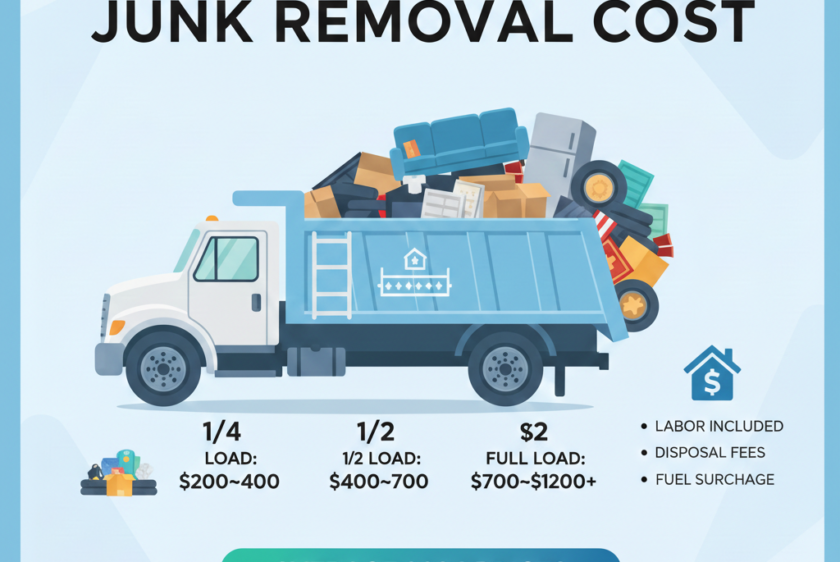
Cleaning out a garage, moving to a new place, or replacing old furniture sounds simple, until the junk pile grows faster than your free time. The big question is usually the same: how much does junk removal cost? In the US in 2026, most junk removal jobs cost between $100 and $800 per load, with an average around $250. Very small pickups can run $70 to $150, but many companies have a minimum charge. The price comes down to a few basics. First is how much space your items take in the truck. Then weight, labor time, and disposal fees push the number up or down. The goal of this guide is to help you spot a fair quote and avoid surprise add-ons. How much does junk removal cost? Typical price ranges by load size and item type Most junk removal companies price the same way a moving truck gets packed: by volume. Think of the truck as a giant measuring cup. If your pile takes up more space, the cost rises. Across the US in 2026, a common “most jobs” range is $150 to $450, with many people paying about $250. Small jobs tend to cost $75 to $200, but minimum fees often sit around $75 to $150. On the other end, a full truck usually runs $600 to $850 and can go higher in high-cost cities. Here’s a simple load-size snapshot to make the pricing feel more concrete: Truckload size About how much fits Typical national price range (2026) Minimum / 1/8 load A few bulky items or several bags $70 to $150 1/4 load Small corner of a garage or a few pieces of furniture $120 to $250 1/2 load Small room cleanout or a moderate garage pile $200 to $450 3/4 load Large room cleanout, bigger garage section $400 to $600 Full truck One-car garage cleanout or a full-home purge $600 to $850 These ranges match how most crews estimate on-site. If you want to see how a local company explains volume-based pricing, check these junk removal pricing details. Junk removal cost by truckload size (1/8 load to full truck) A “fraction of a truck” is just a shorthand for space. It’s not perfect, because piles can be fluffy or dense. Still, it’s the most common system for household junk. 1/8 load (minimum): Picture a recliner and a few boxes, or 8 to 10 trash bags. Many jobs still hit the minimum fee here. 1/4 load: Often a loveseat, a small dresser, and some loose clutter. It can also be a small shed cleanout. 1/2 load: A typical mix from a spare bedroom, like a bed frame, mattress, desk, and extra bags. 3/4 load: A bigger cleanout, like bulky furniture plus stored items from a packed garage wall. Full truck: Common after a move-out or an estate clear-out, with multiple rooms’ worth of items. One caution: quotes can change if the pile grows or if items turn out denser than they looked. A neat stack of “light stuff” can hide heavy books, soaked carpet, or scrap wood. Common item prices: furniture, appliances, mattresses, and yard waste Item-based pricing shows up most with single-item pickups or a small group of similar items. Nationally, you’ll often see: Appliances (fridge, washer, dryer): about $70 to $150 each, sometimes higher if special recycling rules apply. Furniture (sofa, recliner, dresser): often $70 to $150 per piece, with bigger sectionals trending higher. Mattresses: commonly $70 to $150, and some areas add a mattress recycling fee. Yard waste: usually cheaper per volume than heavy debris, but it still depends on weight and how it’s bundled. Labor can also creep in. If a crew has to break down a bed frame, separate a sectional, or remove a door to get a couch out, the job takes longer, so the price can rise. What affects junk removal pricing the most (and why two quotes can be so different) Two quotes for the “same” pile can look wildly different. That doesn’t always mean someone’s trying to overcharge you. It usually means the companies are scoring the job using different risk factors. Here are the price drivers that matter most: Volume (space in the truck) is the main one for household junk. A bulky couch can cost more than a smaller, heavier pile because it takes up truck space. Weight is the next big factor. Dense materials can trigger heavy-debris pricing, even if they don’t fill much space. Labor time affects cost fast. Stairs, long carries, and tight turns slow the crew down. Some companies roll that into the quote; others add an access surcharge. Disposal and recycling fees vary by county and item. Landfills charge tipping fees, and certain items require special handling. Travel and scheduling also matter. Rural pickups can include travel charges. In cities, traffic and parking can add time. Same-day service can cost more during busy weeks. A good quote tells you what it includes: truck space (or item count), labor, and disposal. If those parts are clear, the price usually makes sense. If you’re unsure what counts as “special handling,” it helps to review the common categories of types of junk we remove before you call around. Volume vs weight: why heavy junk costs more even if it takes little space Most household junk fills trucks before it maxes out weight. A couch is a great example. It’s big, awkward, and mostly air. Now compare that with a small pile of concrete chunks. Concrete can sit in one corner and still be too heavy to price like normal junk. In those cases, companies may use weight-based rates, heavy-debris minimums, or separate pricing for dense loads. Roofing shingles, dirt, brick, and tile can fall into the same bucket. If you’re cleaning up a remodel, mention those materials early. It changes the kind of truck space you’re really buying. Labor, access, and disposal fees: the hidden cost drivers Access issues can turn a simple pickup into a slow carry job. Basements, narrow stairwells, long